Telesimulation in Medical Education: Responding to a crisis
By Rami A. Ahmed, DO, MHPE, FACEP, Chief, Division of Simulation, Simulation Fellowship Director, Professor of Emergency Medicine, IU School of Medicine
Telesimulation is the use of videoconferencing capabilities to watch and debrief learners, in real-time, on their performance during a medical simulation scenario by a content expert at a remote location.
The COVID-19 pandemic has had a significant impact on medical education. At the start of the pandemic, many healthcare students and residents had all in-person training canceled with shelter-in-place orders and strict instructions to only report to the hospital for mission-critical clinical care. This significantly affected simulation centers that provide some of the most desired and impactful training to nursing students, medical students, and resident physicians. With no clear timeline as to the length of this mandate, simulation faculty had to adapt to ensure their learners received the training they needed to guarantee the highest level of education. While lecture-based training was easily transitioned to digital platforms like Zoomâ or Webexâ, innovative solutions needed to be developed quickly and effectively.
Simulation training is particularly critical for trainees, especially in acute care fields such as emergency medicine, surgery, anesthesia, obstetrics and gynecology, and critical care. It provides the most effective means to train critical thinking under pressure (crisis resource management), medical decision-making, leadership, and situational awareness that cannot be gained from traditional lectures. Simulation training serves as the mechanism in the curriculum that allows learners to experience rare, challenging, and life-threatening situations, some they may not have seen in actual clinical practice, to ensure they are ready when they encounter those scenarios for the first time in the clinical setting.
What is Telesimulation?
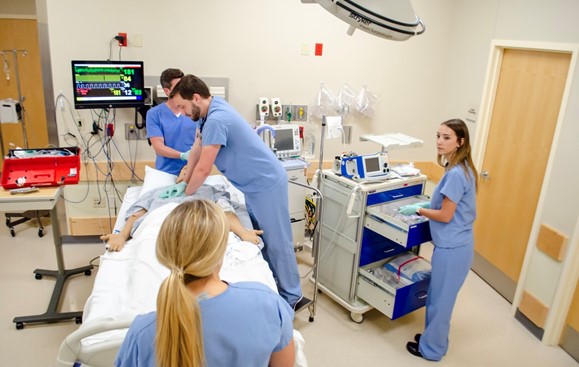
Telesimulation is the use of videoconferencing capabilities to watch and debrief learners, in real-time, on their performance during a medical simulation scenario by a content expert at a remote location. In its most simple form, a group of learners meet at a simulation facility and progress through a clinical scenario with a high-fidelity mannequin that blinks, breathes, and talks. The learners manage the case to the best of their ability. This mannequin and the associated vital signs can either be controlled locally by the simulation technician on-site or remotely by the simulation faculty. This is a dynamic process where the “patient” can improve or worsen depending on the decisions made by the learners.
After a simulated clinical scenario, the faculty member engages in a dialogue (aka the debriefing period), typically exploring the rationale behind the decision-making and team dynamics, discussing areas for improvement in a constructive manner, and reinforcing positive decision-making. This use of a digital communication platform like Zoomâ or Webexâ during simulations eliminates the obstacles of distance, cost, and time away from other commitments that once impeded scholars from disseminating their expertise. This has the potential to open a vast array of educational communities throughout the world that otherwise would not have been realized if not for the push from this pandemic.
Telesimulation challenges and limitations
This new approach to simulation education not only facilitates training and education of learners where a locally available content expert may not be available, but also facilitates the training of learners at off-site or satellite campuses where content experts may infrequently visit. Additionally, it allows for the formal assessment of learners at these offsite locations, saving them from commuting to the main training and testing facilities. This eliminates the cost and distance barriers that once prevented more frequent or high-quality assessment from content experts. It provides the benefits of the simulation beyond the walls of the simulation center and can potentially provide substantial cost savings to programs and institutions. This new approach can also accelerate the dissemination of new knowledge and techniques in medical education towards cutting-edge patient care.
There are, however, some limitations and obstacles that exist with this new platform. This approach is limited by the stability of the internet connection at both sites. This is especially important during the visualization of the students’ performance in real-time that will provide the teaching points from the faculty member after the scenario during the debriefing period. Additionally, technical problems (audio, frozen images) and local technical support (simulator gets disconnected or malfunctions) can provide obstacles that be can be challenging to overcome if contingency plans are not put into place in advance. Furthermore, there can be aspects of learner comfort and stress, especially if the individual providing feedback is a faculty member they are unfamiliar with, discussing their mistakes and providing feedback. This is typically alleviated when undergoing simulations with known local faculty where there is an existing relationship. Additionally, as this potential network of remote scholars grows, the hurdles of widely different time zones and language barriers develops when the option to have scholars dial into your location at any time becomes a reality.
What does the future hold?
The use of telesimulation for medical providers’ training holds significant promise to make the world of immersive high-fidelity medical simulation training smaller and more accessible to learners and content experts globally. There are still many unanswered questions related to the optimal types of simulation training best suited for this digital platform. Scholars worldwide are looking into the effectiveness of this approach and investigating everything from procedural training, to difficult conversations with standardized patient actors, to traditional simulator-based resuscitations at various levels of learner experience to try and identify the optimal utilization of this new method. Additionally, telesimulation can facilitate multicenter simulation-based educational activities leading to more generalizable academic research that has historically been very hard to achieve using traditional approaches. This new method is here to stay and will change the way medical education is carried out around the globe.